
Dynamic call planning in life sciences sales is the process of continuously optimizing which HCPs a sales rep should visit and when they should visit them based on changing information. Dynamic call planning uses near real-time data to adjust recommendations on a week-to-week or even day-to-day basis. Signal-IQ provides a unique high-value source of information that should be used for those recommendations.
Signal-IQ is a competitive field intelligence platform that provides real-time NPI-level visibility into competitor sales activity with specific HCPs of interest to your brand and sales teams.
A Key Missing Ingredient for Dynamic Call Planning - Competitor Sales Team Interactions with your Target HCPs
Most dynamic call planning algorithm-based recommendations use dozens of secondary-data features derived primarily from prescribing/testing data sources integrated with internal sources capturing interactions with promotional efforts. Much of that information is delayed, asynchronous and ofen re-stated. Dynamic call planning algorithms never take into account HCPs' recent interactions with competitive sales forces simply because the data has never existed with timeliness and precision. Signal-IQ provides just that – near real-time NPI-level information on which competitor sales teams your HCP targets interacted with.
How Dynamic Call Planning Can be Improved with Signal-IQ
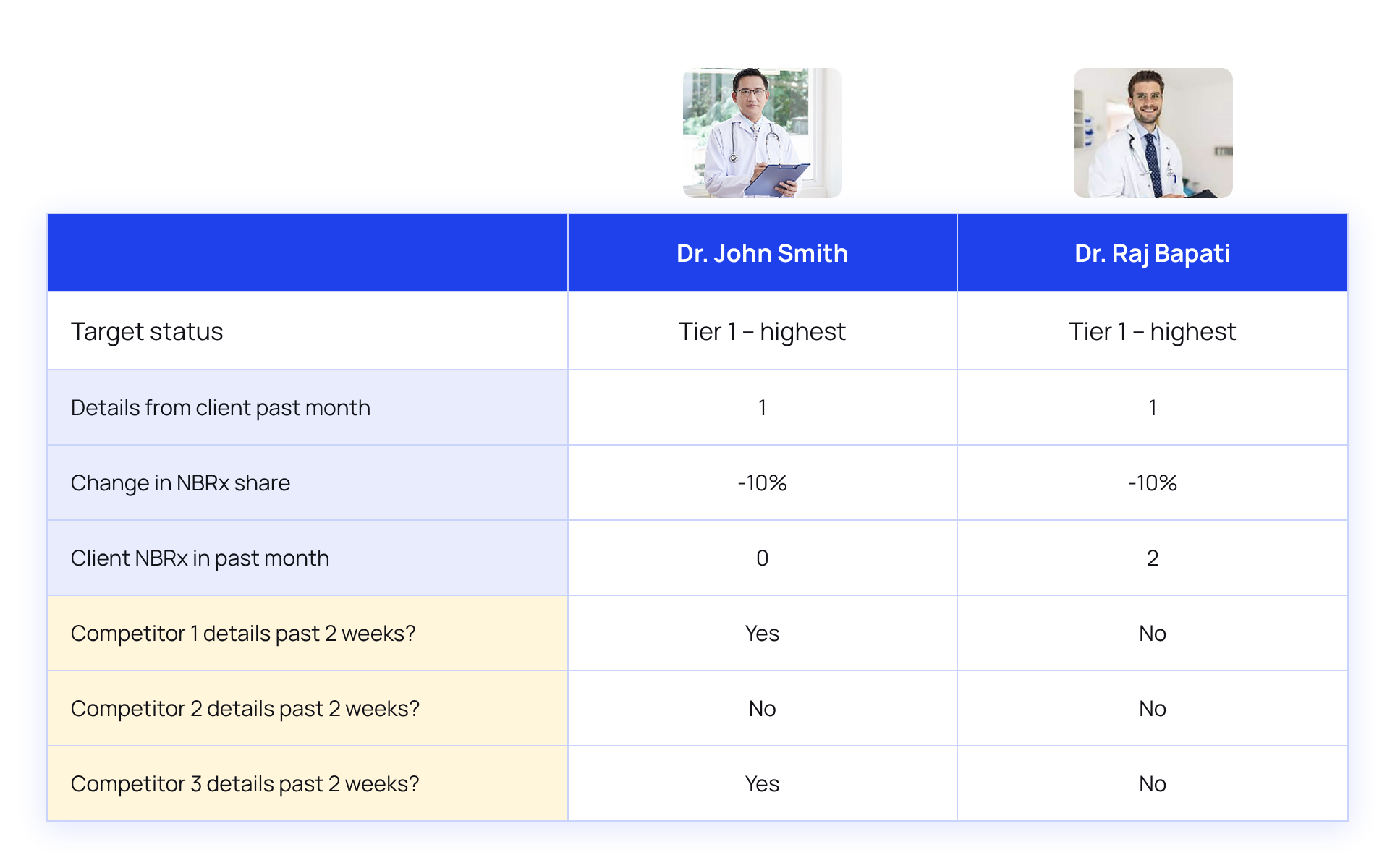
In the illustrative example below, Drs. Smith and Bapati are both identified as Tier 1 targets for a client. Based on traditional CRM inputs such as prescribing behavior and historical interactions with the sales force, the pre-call planning system generates the same profile and priority for both HCPs (shown in blue below).
However, Signal-IQ provides a deeper layer of insight. It reveals that Dr. Smith has engaged with two key competitor sales teams in the past two weeks, while Dr. Bapati has had no recent competitor interactions. Armed with this intelligence, the sales rep can make a more informed decision and prioritize Dr. Smith where competitive activity suggests a more immediate need to engage and influence the HCP.
Turning Signal-IQ Competitor Information into Opportunity and Threat Signals
In the illustrative example below, Drs. Smith, Bapati and Ruiz are identified as Tier 1 targets for a client. The CRM generates the exact same information for all 3 HCPs based on prescribing and patterns of interaction with their sales force (in blue in table below). Using Signal-IQ to get more resolution for the 3 HCPs, we would see distinctly different pattens of interactions with competitors in terms of breadth, depth and trajectory. Dr. Smith poses a severe risk for the rep given the breadth, depth and trajectory of competitive interactions, while Dr. Bapati poses a moderate risk and Dr. Ruiz a low risk.
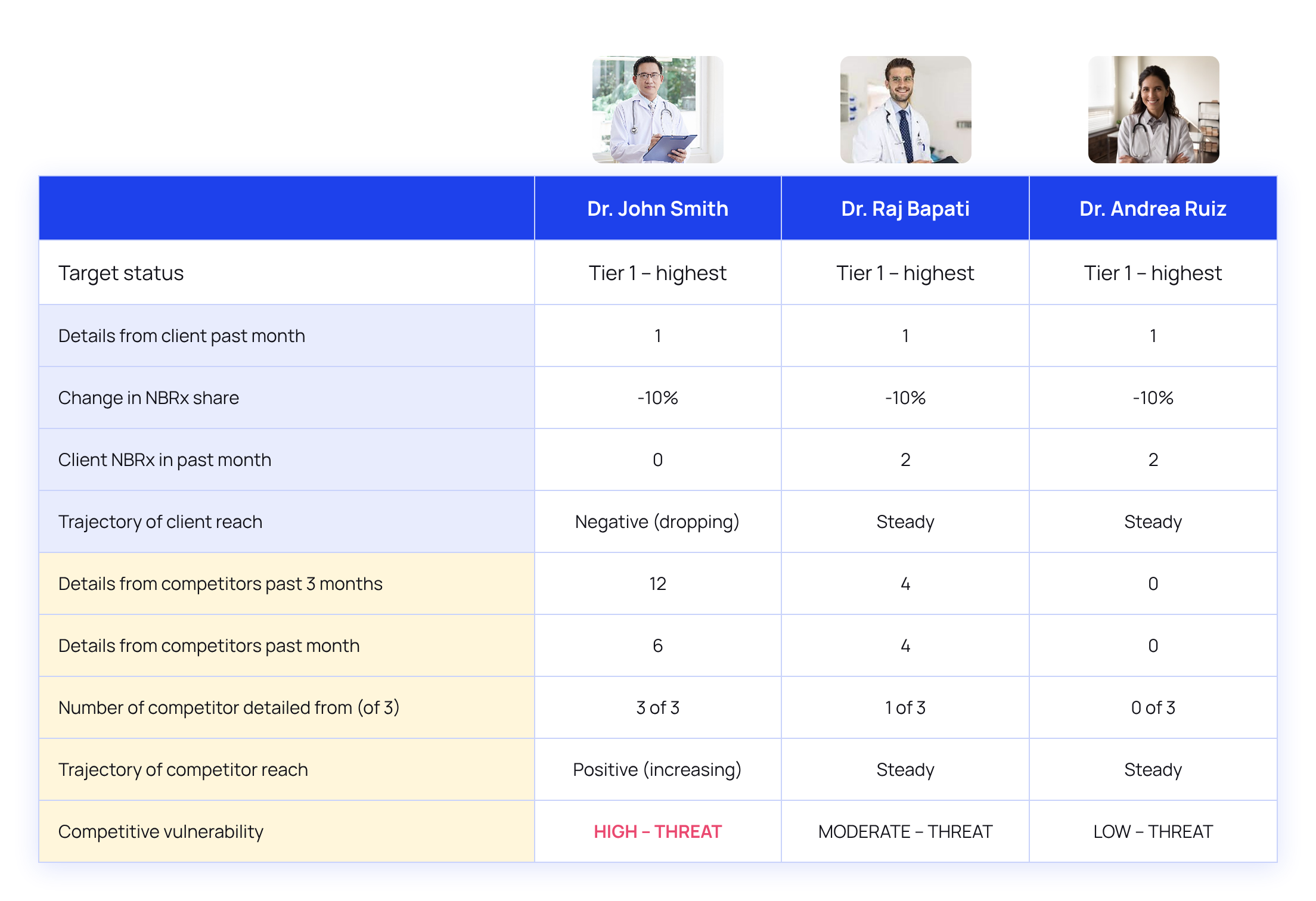
Signal-IQ clients will generally work with the ZoomRx team to create custom NPI-level competitive vulnerability scores, or client teams will use the bi-weekly NPI-level Signal-IQ data to create their own high-value indices.
Adding Competitor Data to the Dynamic Call Planning Workflow & Market Understanding - Example Application
- Receive the refreshed feed. Signal-IQ: Competitive Field Intelligence updates weekly or bi-weekly showing which HCP targets each competitor sales team reached in the past two weeks.
- Flag Threats or Opportunities. Identify priority HCPs recently reached by competitors and compare with any relevant internal information but most importantly interaction patterns with their own field force.
- Adjust the next short-term call cycle. Consider reprioritizing the call list using the information.
- Send the signal to the field. Feed flags into CRM and next-best-action workflows so reps see them before the call.
- Review competitive pressure by territory. Use territory and state views of geographic competitive activity and derived indices to inform thinking on targeting, reach, and maybe territory design at the next planning cycle.
Learn More
Signal-IQ: Competitive Field Intelligence gives sales operations and brand teams NPI-level competitor field activity on a weekly or bi-weekly cadence so call plans can respond to competitive pressure in real time. Signal-IQ: Competitive Field Intelligence turns anonymized mobility signals into NPI-level intelligence on competitor field force activity with your HCP targets. Explore Signal-IQ: Competitive Field Intelligence, or contact us to schedule a walk through on how this completely unique source of information can be used to drive competitive advantage for your brands and better outcomes for your patients.
Frequently Asked Questions