·
2 minute read
·
2 minute read

For pharma brand teams, the patient journey has long been a puzzle with missing pieces. You have the claims data, the "what" telling you which drugs were dispensed and when. But the most critical piece of the puzzle remains hidden: Why did the physician make that specific choice?
Traditional research methods often fail to bridge this gap, leaving insight leaders with strategic blind spots and unreliable forecasting.
Below, we've distilled five structural warning signs that your patient chart audit program may be underperforming, illustrated in our diagnostic checklist infographic along with a clear picture of how modern, AI-powered chart audit approaches are closing those gaps.
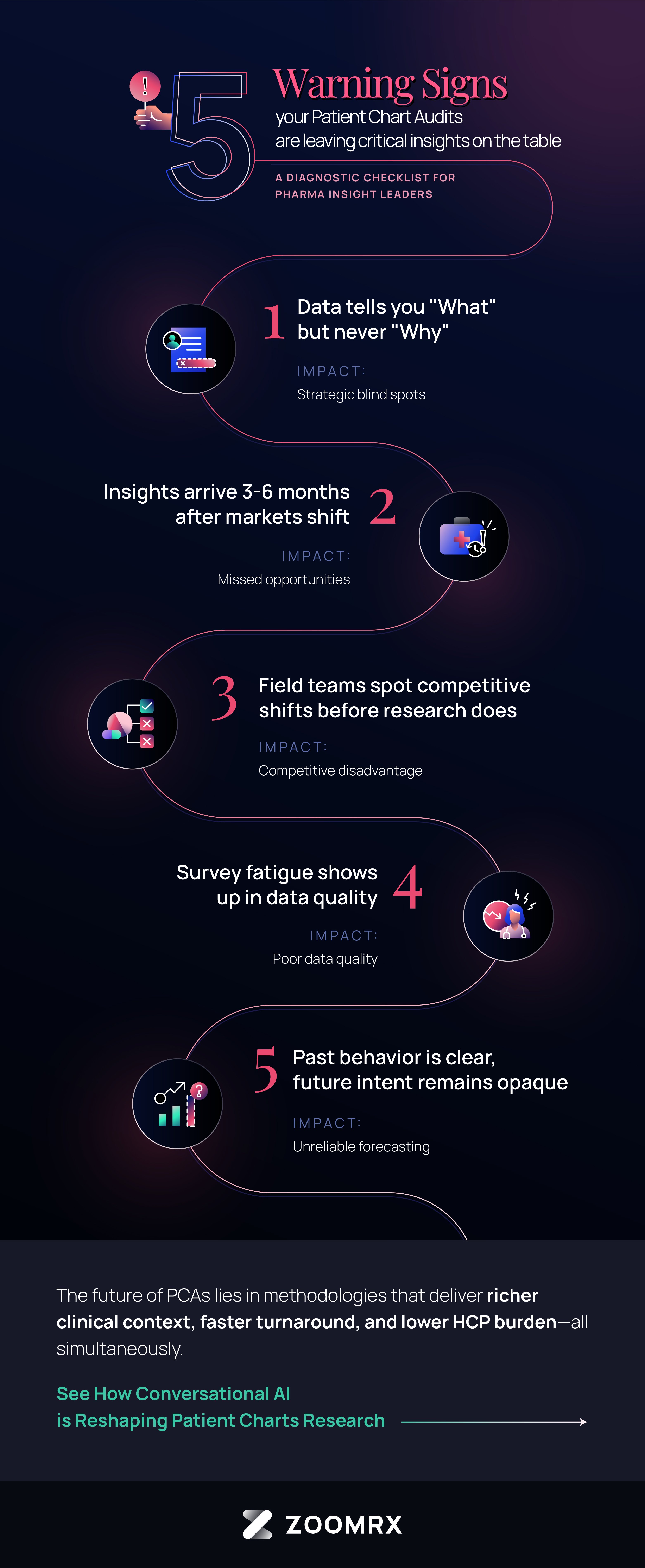
Breaking Down the 5 Warning Signs
Here's a closer look at what each warning sign means in practice:
-
Data tells you "what" but never "why"
Impact: Strategic blind spots
Claims data and structured chart forms document treatment events but cannot capture the clinical reasoning, competitive considerations, or access barriers driving physician decisions. Without the "why," brand strategy is built on incomplete foundations. -
Insights arrive 3–6 months after markets shift
Impact: Missed opportunities
Traditional PCAs operate on long turnaround cycles. By the time insights reach strategy teams, the competitive landscape has already moved. Real-time patient journey analytics are no longer a luxury, they are a baseline requirement. -
Field teams spot competitive shifts before research does
Impact: Competitive disadvantage
When sales reps are your early warning system for competitive dynamics, your research program has a structural lag problem. Systematic pharma patient journey mapping should surface those signals first. -
HCP survey fatigue shows up in data quality
Impact: Poor data quality
Manual Patient Record Forms (PRFs) demand significant cognitive effort from physicians already managing full patient loads. The result: rushed responses, skipped questions, and shallow data that undermines the entire research investment. -
Past behavior is clear, future intent remains opaque
Impact: Unreliable forecasting
Traditional chart audits excel at documenting historical treatment patterns. But without conversational probing that surfaces next-step intent and forward-looking clinical reasoning, forecasting remains speculative.
These aren't isolated problems, they're interconnected symptoms of a methodology that was never designed to meet the demands of modern pharma brand strategy. The good news: the structural gaps are well understood, and the solutions are already in use at leading life sciences organizations.
The Solution: Patient Scribe by ZoomRx
To get deeper insights, you need a better conversation. Patient Scribe is a voice-first, conversational AI platform designed to transform the chart audit from a burdensome survey into a strategic dialogue.
Built on Sagan, ZoomRx’s proprietary AI engine, Patient Scribe allows physicians to narrate patient stories naturally. As they speak, the AI intelligently probes for missing details such as switching triggers or therapy sequencing, ensuring 100% data completeness without the "prefer not to answer" shortcuts common in manual forms.
Why Leading Pharma Brands are Switching
- Deeper Clinical Detail: Capturing the nuanced reasoning that "checkbox" surveys miss.
- Rapid Turnaround: While traditional vendors struggle with manual transcription, Patient Scribe has delivered 800+ charts in just 8 weeks.
- Oncology Leadership: ZoomRx brings deep expertise in complex oncology markets where clinical nuances matter most.
Watch our PMRC session to see how conversational AI is transforming oncology patient chart audits and insight generation. - Better HCP Engagement: 77% of physicians prefer the voice modality, leading to richer, higher-quality real-world evidence.
Stop waiting for quarters to get the answers you need in days. and start capturing the clinical "why" behind every treatment decision.
Frequently Asked Questions