·
3 minute read
·
3 minute read
A specialty oncology brand at a top-twenty pharma had four message claims, all rated effective in standalone testing. Intent was softening anyway. The fix was not in the content. It was in the order.
Insights in this article are drawn from the ZoomRx whitepaper, Blind Spots in Launch Tracking: Why Standard Research Isn’t Enough.
Most pre-launch message-testing exercises end with a winner. One message scores highest on perceived effectiveness, one scores highest on intent, and the team builds the field force narrative around them. But launch message sequencing, the order in which those messages are delivered in a rep’s call is the variable most testing never captures.
That is the right exercise. It is just not the whole exercise. What the highest-tested messages do in the rep's hand depends on something most testing never measures, which is the order they are delivered in.
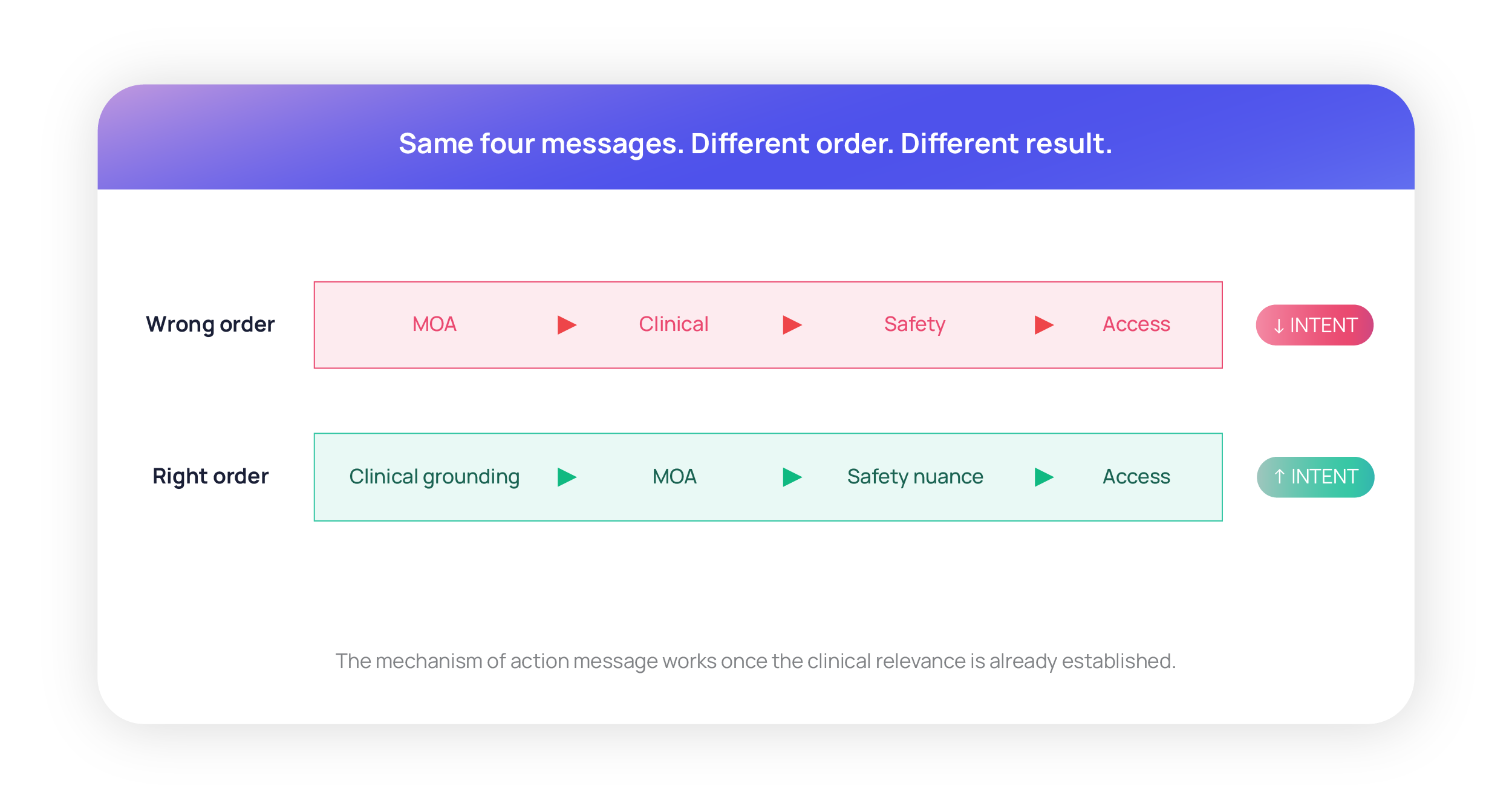
Same four messages. Different order. Different result. Illustrative, not from a specific brand.
The Launch Message Sequencing Puzzle: When Content Testing Isn’t Enough
A specialty oncology brand at a top-twenty pharma had launched with four message claims. All four had tested as effective in standalone work. The mechanism of action (MOA) message had rated highest. The expectation was that the field force should lead with MOA.
A few months into launch, something did not add up. Specialists who recalled the messages were softening on prescribing intent. Scripts were not tracking to forecast. The team was internally divided. Half wanted to double down on MOA. Half wanted to lead with the clinical numbers. Both sides had opinions. Neither had a clean read.
Why Standalone Message Testing Cannot Answer the Sequencing Question
For field excellence and marketing teams running multi-message playbooks, this is the gap that quietly costs launches. Standalone message testing measures whether a single claim lands. It does not measure how that claim performs when it follows another claim, or when it is delivered first. In a real rep interaction, messages do not arrive in isolation. They arrive in sequence.
The order matters because clinical conversations build on themselves. A message that needs the clinical relevance to be established first does not work when it is the opening line. A message that grounds the rest of the conversation does not work when it shows up last.
Brand teams argue about content because content is what they can see. Sequence is what they cannot.
What the PET Sequencing Analysis Surfaced
The whitepaper walks through the specific instrument that surfaced the answer, which was a sequencing analysis layered onto a Promotional Effectiveness Tracker (PET) read. For every specialist who recalled two or more priority messages, the team captured the order the messages had been delivered in and tied that order to stated likelihood to increase or start prescribing.
The blunt finding was that intent to increase prescribing depended on where the highest-tested message landed in the rep's call. When that message came first, intent was meaningfully lower than when it came later, after another message had opened the conversation. The drop showed up across all four messages but was sharpest on the one the team had been planning to lead with.
A short qualitative read explained the why. Specialists said the message worked best once the clinical relevance was already established. The rebuilt sequence the field force was retrained on followed a familiar shape: clinical grounding first, then MOA, then safety nuance, then access. The same four messages. A different order. A different result.
What This Means for Any Pharma Launch Running a Multi-Message Playbook
If your launch is running a multi-message playbook, three questions are worth asking, even before any new research.
- Have we tested our messages standalone, or have we tested them in sequence?
- Does our field force have a fixed open, or is the opening message left to the rep?
- If our highest-tested message dropped on intent when it was delivered first, would our current instruments surface that in time to fix it?
For most brands, the honest answers are 'standalone,' 'left to the rep,' and 'no.' None of those are failures. They are simply the gap between message testing as it is usually done and message effectiveness as it actually plays out in field.
What Good Launch Message Measurement Looks Like
A sequencing read is not a separate research project. It is a layer on a Promotional Effectiveness Tracker (PET) that captures message recall plus the order of delivery, and ties both to behavioral intent. Inside ZoomRx Launch Excellence programs, the sequencing layer is added when the messages are right but the intent curve is starting to soften. It is the difference between asking 'is the message working' and asking 'is the message working in the position we are placing it.' The first question is necessary. The second is what changes the call.
"Brand teams argue about content because content is what they can see. Sequence is what they cannot."
See the full sequencing read
How the team set up the read, what they saw, and the corrected sequence the field force was retrained on are in our latest launch whitepaper. For a closer look at how this kind of read is designed inside Launch Excellence engagements, the team would walk through it on a working call.

Talk to the ZoomRx Launch Excellence team
If your launch is running a multi-message playbook and intent is starting to soften, our team can help you add a sequencing layer to your existing measurement before the field cycle ends.