·
3 minute read
·
3 minute read

For a launch into a new prescriber population, monthly or quarterly tracking will tell the team what happened. Just not in time to do anything about it.
Insights in this article are drawn from the ZoomRx whitepaper, Blind Spots in Launch Tracking: Why Standard Research Isn’t Enough.
For most of the industry, the cadence question is treated as solved. Trackers run monthly.
Some run quarterly. The cadence is set early in the brand plan, gets ratified by procurement, and is not revisited.
That is fine for steady-state. It is not fine for a launch into a new prescriber population, where the variables are moving on a different clock than the tracker is.
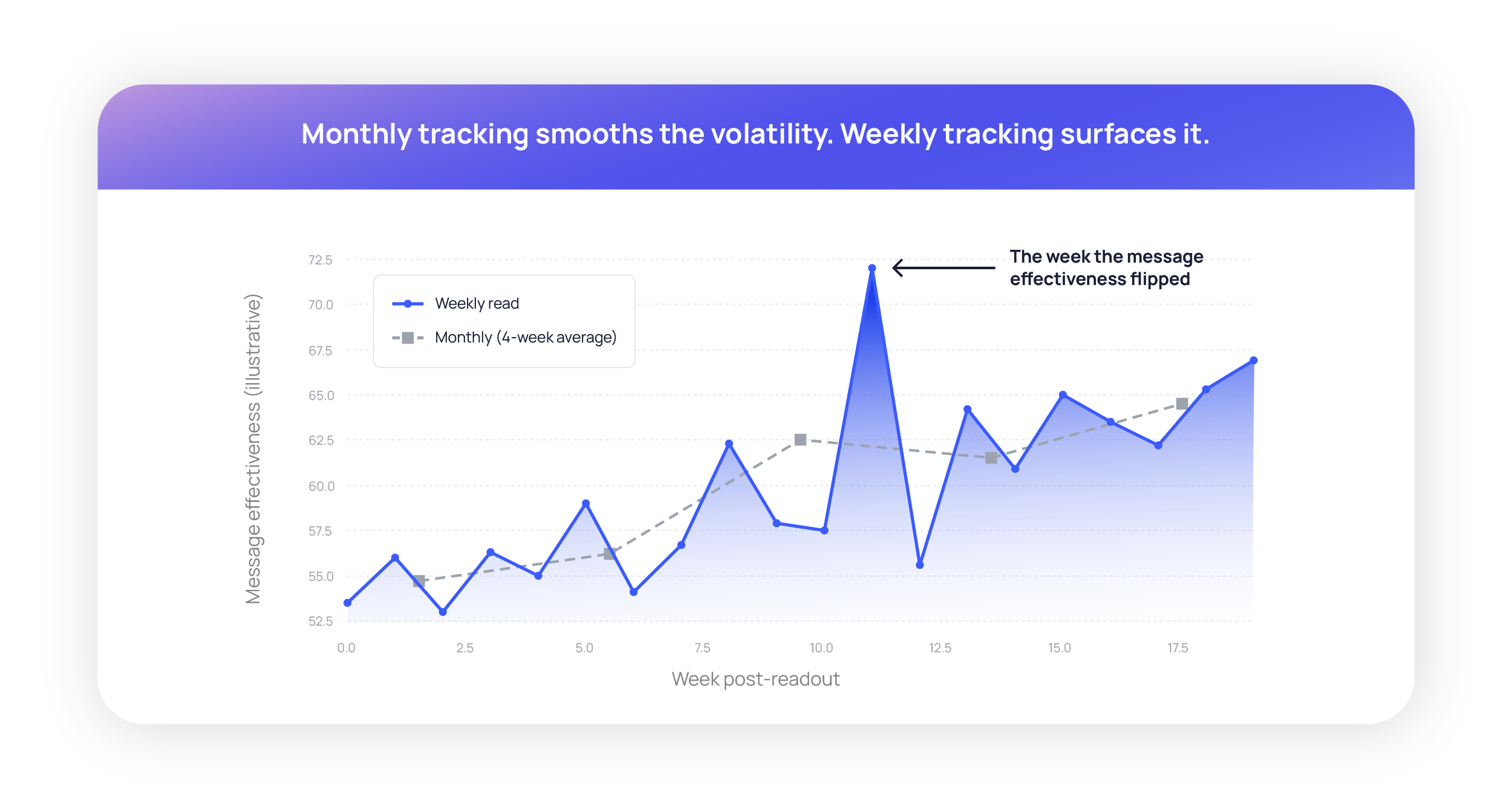
Monthly tracking smooths the volatility. Weekly tracking surfaces it. Illustrative, not from a specific brand.
The Launch That Exposed the Cadence Gap
A top-five pharma chronic disease brand had a positive readout in an expanded indication. The addressable patient pool multiplied by an order of magnitude. The brand had been fishing in a pond. Now it had the sea.
The catch was that the new population sat almost entirely with primary care physicians (PCPs). Most of those PCPs had never written the brand. Six weeks after the readout, the field force flagged something soft. PCP receptivity was lower than the modelling had predicted. Specialists, on the other hand, were tracking to plan.
The team had two choices. Wait for the next monthly tracker to confirm what the field was already seeing. Or commission a faster read while the launch budget was still being deployed.
Launch Tracking Cadence Is a Strategic Decision, Not an Operational Default
For insights and analytics owners of launch tracking, this is the call that decides whether the team catches a swing or misses it. Most trackers are designed for stability. Steady awareness movement. Steady message recall. Steady prescribing trend. Monthly cadence is plenty for any of that. That kind of tracker reads position, not motion.
A launch into a new prescriber population is not stable. Awareness curves are still forming. Message effectiveness is still finding its level. Two audiences (PCPs and specialists) are being asked to absorb a new dataset on different timelines. Inside that volatility, monthly tracking will give the team an average, smoothed out across four weeks, that hides everything interesting that happened inside the four weeks.
A weekly read does not smooth the volatility. It surfaces it. Position tells you where things sit. Motion tells you which way they are moving and how fast. In a launch window, motion is the variable that decides the call.
What Weekly Launch Tracking Cadence Surfaced That Monthly Would Have Missed
The full read is in the whitepaper, but the headline matters here. The two audiences were responding to fundamentally different things, and the aggregate read across all health care professionals (HCPs) was masking the divergence. The audience-split view (PCPs against specialists) exposed it. And the weekly cadence caught a week-over-week effectiveness swing on a key message that monthly tracking would have averaged away entirely.
The team rebalanced PCP-targeted spend, rotated out the underperformers, and held the launch trajectory through month five instead of discovering the mismatch at month nine.
The PCP vs Specialist Audience Split: The Launch Tracking Lesson Worth Carrying
It is tempting to read the lesson as 'go weekly.' That is half of it. The other half is the audience split. The same dataset, read across all HCPs at once, said one thing. Read PCPs against specialists separately, it said something different, and the difference is what the team acted on.
In any launch expanding into a new prescriber population, where the new audience does not behave like the existing one, the aggregate read is the read most likely to mislead. PCPs and specialists are absorbing the new data on different timelines, weighing different parts of the message, and responding to different things in the rep's call. A tracker that does not separate them is not really reading the launch.
What This Means for Your Launch Tracking When Expanding Into a New Prescriber Population
Three questions worth sitting with before the next launch readout.
- Is our tracking cadence set by the brand plan, by procurement, or by the volatility our launch is actually facing?
- If two audiences (PCPs and specialists, academic and community, urban and rural) are absorbing the new data on different timelines, would our current tracker surface that divergence or smooth it away?
- If a key message swung in effectiveness in a single week, would we know in time to act on it?
For most launches expanding into a new prescriber population, the honest answers are 'the brand plan,' 'smooth it away,' and 'no.' Those answers were the same for the team above. The difference was that they noticed, and changed the cadence, before the launch window closed.
What good launch message measurement looks like here
A weekly post-readout pulse study is not a heavier version of monthly tracking. It is a different instrument, designed to read motion rather than position. Stated and derived motivation scoring lets the team see not just which messages are landing, but which are actually moving behaviour.
Audience splits separate the two responses before the aggregate read can hide them. ZoomRx Launch Excellence is built around exactly this kind of question-driven cadence: monthly when the launch is steady, weekly when the launch is volatile, audience-split whenever the audiences are not the same.
"Monthly tracking will give the team an average, smoothed out across four weeks, that hides everything interesting that happened inside the four weeks."
See what the team actually did
The full read on what the weekly cadence surfaced, including the message swing, the audience-split picture, and the spend rebalance, is in the Blind Spots in Launch Tracking: Why Standard Research Isn’t Enough whitepaper. For a closer look at how a weekly read would fit inside your current Launch Excellence stack, the team would walk through it.

Talk to the ZoomRx Launch Excellence team
If your launch is expanding into a new prescriber population and your tracker still runs monthly, our team can help you design a weekly read with audience splits before the next field cycle.