
Something was moving through exam rooms, and the brand team couldn’t see it. Dermatologists were describing a client brand’s gastrointestinal side effects to patients in language nobody on the brand team had written or chosen: usually guaranteed in the first few weeks, loose and runny, hard to tolerate after a month. The words were accurate. The framing was overstated, and it was showing up before the treatment decision was even made, which is exactly when a side effect does the most damage to whether a patient starts therapy at all.
ZoomRx ran HCP-Patient Conversations research and Promotional Effectiveness Tracking on the same dermatology brand for 13 months, with the same consulting team reading both studies. That pairing is what made the pattern visible. Neither study on its own would have shown it, because the brand hadn’t changed a word of its own safety messaging. Its reps were on the same schedule, saying the same things they’d always said.
Because the conversations were being read as they happened, rather than reconstructed a year later from a single end-of-study readout, the brand team could watch the misconception take shape, work out what was feeding it, and respond while it still mattered.
Counter-Detailing: The Conversation a Brand Isn’t In
Counter-detailing is when a competitor’s reps bring up a rival brand’s weaknesses, usually side effects, dosing burden, or an efficacy gap, during their own calls with a physician. It’s a normal part of competitive selling. What makes it hard to deal with is that it happens in a room the targeted brand isn’t in. A promotional tracker is built to measure what a brand’s own reps say and what physicians remember about that brand. It isn’t built to catch what a competitor’s rep said about the brand five minutes before the brand’s own rep walked in. For a commercial team running promotional tracking on its own brand, that’s the core limitation: the tool was built to look inward, not sideways.
That’s the blind spot, and this case shows exactly how it plays out.
The Language Moved Before Anything Else Did
ZoomRx had access to real, consented, de-identified recordings of dermatology appointments, not survey recall, not a physician’s memory of a conversation from three weeks earlier. Reading the transcripts in order shows a pattern that would be very hard to see any other way. Coding the transcripts, the team sorted how side effects came up into four rough buckets: naming the problem outright, putting a limit on how common or serious it was, offering a concrete way to handle it, or downplaying it as not worth worrying about.
In the earliest wave, side effects mostly came up unqualified, though not entirely. Most doctors named the symptom and moved on:
HCP: GI issues usually guaranteed in the first few weeks.
HCP: Loose, runny stool.
HCP: Can’t tolerate it, especially after a month.
A couple of conversations already included some way of handling it, even this early:
HCP: Starter pack will mitigate, slowly increase dose.
HCP: GI issues can be managed.
By the second wave, the balance had shifted further toward limiting and managing the symptom, though the harder framing hadn’t disappeared:
HCP: Many patients get GI symptoms.
HCP: Dosing titration helps mitigate GI issues.
HCP: Not had patients who stopped because of GI issues.
HCP: Can use Imodium.
HCP: Goes away quickly.
HCP: GI issues not typical.
Some doctors were still naming a real limit, alongside those:
HCP: Some patients have to discontinue if symptoms persist.
By the third wave, the same symptom had become something closer to a footnote, most of the time:
HCP: Vast majority of patients don’t get them, wouldn’t be overly concerned.
HCP: That’s the reason we start you on a lower dose.
HCP: Tends to get better with time, only first few weeks.
HCP: Most patients tolerate it well.
HCP: Imodium over the counter will help manage.
One clinician was still framing it as something to plan around rather than dismiss:
HCP: If can’t tolerate it, we’ll switch.
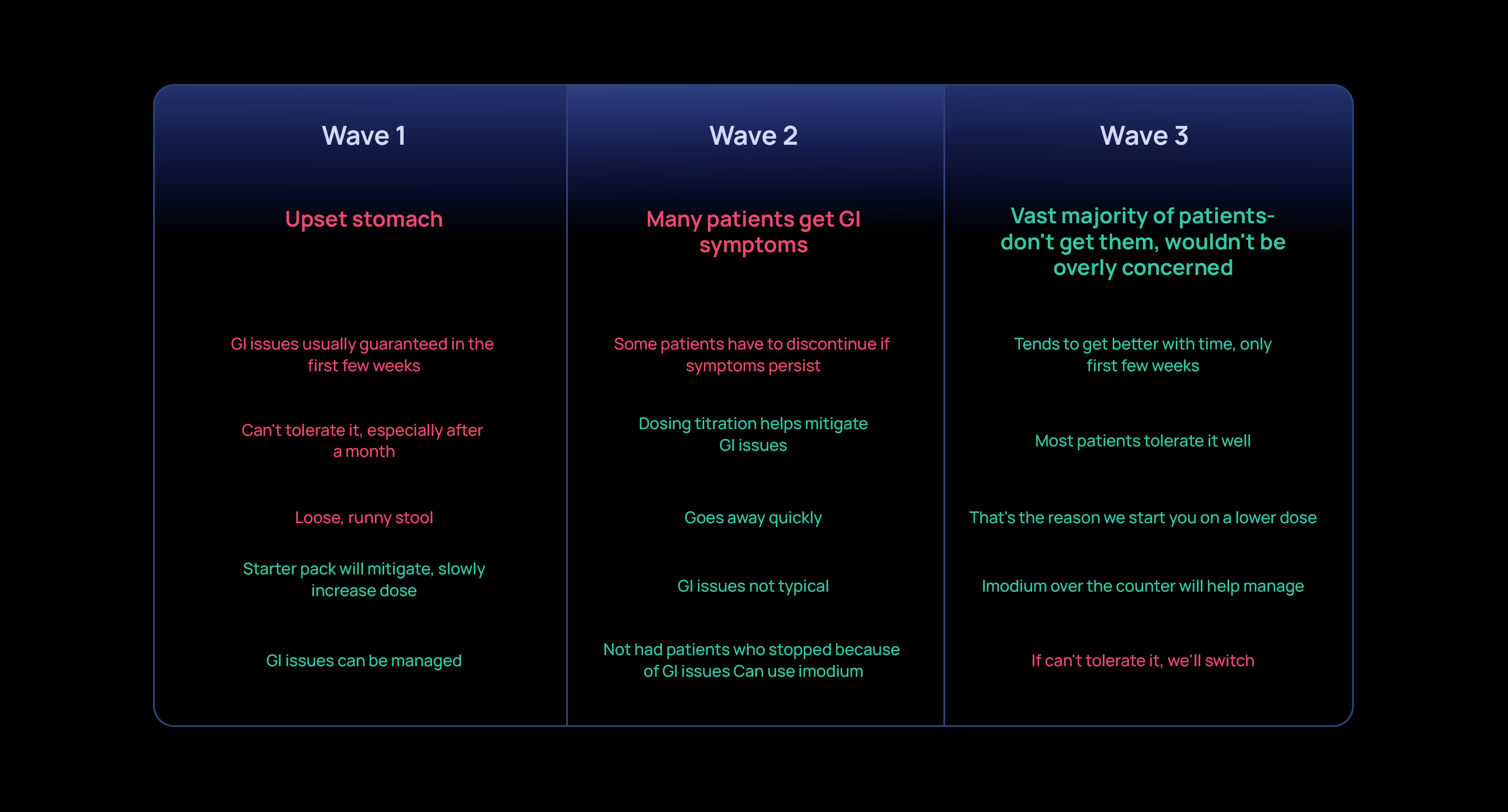
Visual 1. How dermatologists described the same side effect to patients across three tracking waves. Color marks whether the symptom was left unqualified or bounded and managed.
Put the early and late language side by side and the trend is visible before counting anything: the early discussions are a symptom list, the later conversation is a management plan, even though neither wave was ever fully one or the other. The tracked measure confirms it. Side effects raised as an aside after the treatment decision was already made, rather than as a factor in it, went from roughly one in eight of these conversations to more than two in five over the study period.
Research Workstreams Should Inform Each Other in Real Time
The conversation data showed what was being said. The promotional tracker showed where it was coming from.
In the promotional study, dermatologists rarely recalled the brand’s own reps raising side effects at all, at least not unprompted, even though side effects still came up in the large majority of appointments. Because ZoomRx made a point of tracking possible outside influences on doctors’ opinions of the side effects, the promotional study picked up something else: competing reps counter-detailing on that exact issue. Promotional tracking hadn’t started yet in the first wave, so there’s no counter-detailing figure for that wave to compare against, only the second and third. As that counter-detailing eased off between those two waves, the framing dermatologists carried into the exam room eased right along with it.
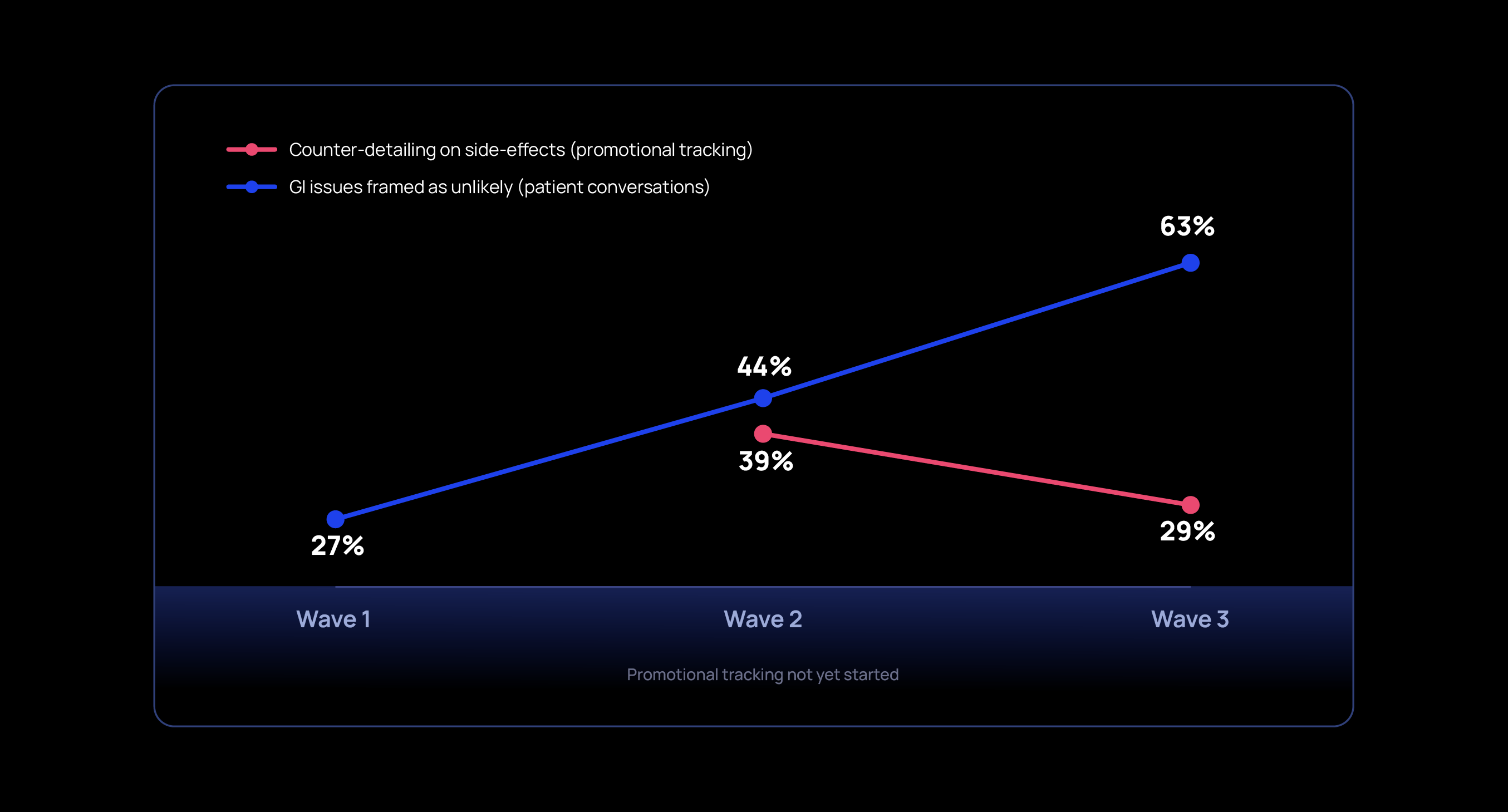
Visual 2. Directional. Counter-detailing on side effects eased while dermatologists’ own reassurance rose. Two studies on two bases, so co-movement rather than correlation.
Across the three waves, the share of conversations where GI issues were framed as unlikely to be a real problem rose from 27 percent to 44 percent to 63 percent, while competitor counter-detailing on side effects dropped from 39 percent to 29 percent between the second and third wave. This is directional, not causal proof. The two studies ran on different bases, so what’s shown here is co-movement, not correlation in the statistical sense.
The mechanism is worth sitting with. A brand’s own share of voice on a topic is not the only thing that determines how clinicians speak about it. Finding the real influence on a conversation means knowing where to look, and the best places to look are rarely obvious. Capturing exam-room audio is what let ZoomRx’s team redirect its attention toward something it wasn’t yet aware was happening.
What This Means If You Run a Brand
Message pull-through isn’t a single-channel question. A brand can hold its safety story completely steady, change nothing about its own detail, and still watch the way clinicians describe it to patients drift substantially, because the lever sits in someone else’s bag. For commercial and insights teams running Promotional Effectiveness Tracking or an ATU tracker on a brand, that’s the practical takeaway: a steady safety story on paper doesn’t guarantee a steady safety story in the exam room.
When months are critical, unknown unknowns are the hardest thing to stay on top of. A brand team can track what it already knows to look for. Everything outside that, it has to be there for. By the time something like this registers in share or in perception data, it has already been true in exam rooms for a while.
If a brand already runs promotional tracking and has never heard how its clinicians talk to their patients, it’s measuring the first half of a two-part sentence. Running HCP-Patient Conversations research alongside Promotional Effectiveness Tracking captures the pull-through, and shows whose messages are actually being represented in the exam room.
How This Was Captured
HCP-Patient Conversations records real, consented appointments between clinicians and their patients. Promotional Effectiveness Tracking measures what representatives are saying to clinicians and what those clinicians take from it. Running the two side by side, on the same brand, in the same therapeutic area and the same time window, is what made this pattern visible. All conversation excerpts in this piece are real and de-identified.
That’s a different operating model from running one study, waiting for the readout, and commissioning a second study later to explain it. By the time a follow-up study is scoped and fielded, the exam-room conversation has usually already moved again. Reading both workstreams in parallel is what let this one get caught while it was still happening.
For background on how this kind of exam-room methodology compares to legacy conversation-research vendors, see ZoomRx vs. Verilogue: How HCP-Patient Conversation Research Has Changed. For a similar dynamic playing out around a treatment decision in a different therapeutic area, see What Happens in the Exam Room When an NSCLC Treatment Decision Is Made? And for how a treatment choice actually turns into a patient starting therapy, the companion piece on oral versus injectable decisions in psoriasis uses this same HCP-Patient Conversations methodology.
Brands that want to see what a pairing like this could surface on their own data can get in touch with ZoomRx.