·
2 minute read
·
2 minute read

Pharma teams track visits, meetings, and follow-ups. Oncologists are evaluating something else entirely. New ZoomRx research shows a 50-point gap between the best and worst MSL teams in oncology, and most companies do not know where they sit on the map.
Insights in this article are drawn from the ZoomRx Oncology Medical Engagement Perception Report 2026, a perception study of 51 US oncology specialists (academic and community) who had interacted with at least one MSL team in the prior three months.
Most oncology pharma companies cannot tell you, with data, where their medical science liaison (MSL) team sits relative to the field. Their dashboards say green. Their oncologists are not being asked. That is the gap this article is about, and it is wider than most teams want to admit.
A 50-point spread, hiding in plain sight
The ZoomRx study asked 51 oncology specialists to rate every manufacturer’s MSL team they had recently interacted with, across seven attributes weighted by oncologist-assigned importance: Scientific Depth, Responsiveness, Communication and Engagement, Research Collaboration, Objectivity and Trust, Tailored Practice Relevance, and Quality of Materials.
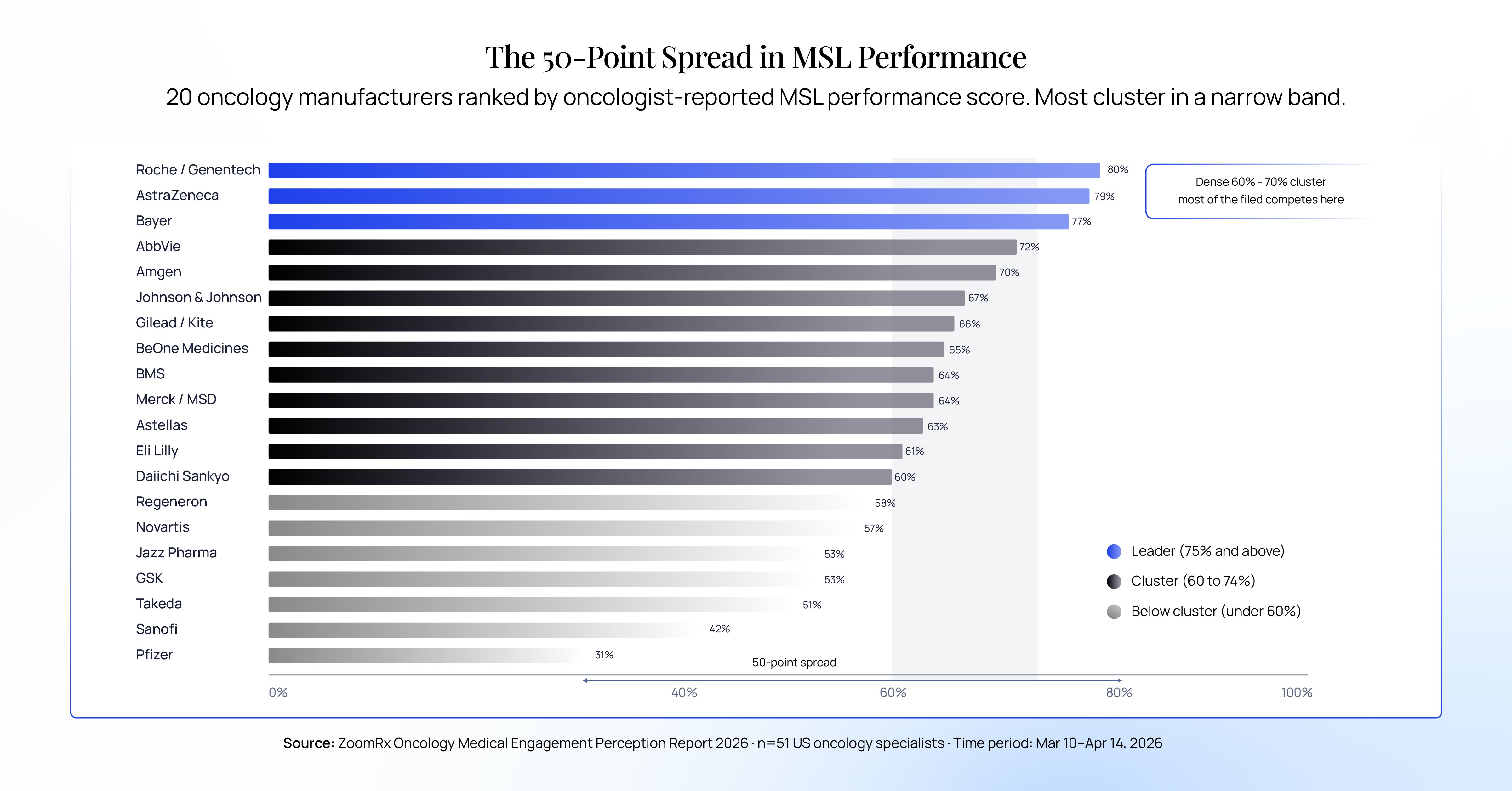
The results were sobering. The top-performing MSL team scored 80 percent. The bottom scored 30 percent. A 50-point spread inside a single specialty.
What is more uncomfortable is the cluster in the middle. Most manufacturers sit in a narrow 60 to 72 percent band, competing for marginal separation. A handful pull meaningfully ahead. A handful sit meaningfully behind. Almost none of them know which group they belong to, because their internal metrics do not surface it.
What gets measured vs what matters
Here is the disconnect. Most MSL KPIs are built around activity: number of HCP interactions, number of slide decks delivered, number of follow-ups completed. Easy to collect. Easy to roll up into a quarterly report.
Oncologists do not experience interactions as activity counts. They experience them as scientific depth, responsiveness, clarity, and access. They walk away with either a clearer view of a complex therapy, or a feeling that the conversation did not help them. And they remember which manufacturers consistently deliver one over the other.
When the study asked oncologists what they actually got out of MSL interactions, the top three answers were:
- Closing a knowledge gap on a complex therapy (41 percent)
- Activating a research conversation or trial discussion (39 percent)
- Connecting them to peers and KOLs in the field (37 percent)
None of those show up cleanly on an MSL activity dashboard.
“Counting MSL activity tells you almost nothing about whether the relationship is being earned or quietly lost.”
Why the gap is widening
Two things are making this measurement gap worse, not better.
First, the conversations themselves are getting harder. Oncology pipelines are denser than they have ever been. Bispecifics, antibody drug conjugates, cell therapies, and combination regimens are all coming through at once. An MSL who can navigate that complexity earns credibility. One who cannot lose it fast.
Second, the standard for good is being set externally. Once an oncologist has a substantive interaction with one manufacturer’s MSL team, every other team is being judged against that bar, whether the other companies know it or not.
How ZoomRx’s Medical Engagement Effectiveness Tracker closes the gap
This is the gap Medical Engagement Effectiveness Tracker (MET) was built for. MET is ZoomRx's HCP-direct MSL measurement system capturing share of voice, interaction quality, scientific narrative effectiveness, and competitive standing in your therapeutic area, on a continuous basis. The oncology findings in this report show what that kind of measurement surfaces. The dashboard you build internally tells you what your team did. MET tells you what your physicians actually got out of it.
If you do not know how your MSL team is actually perceived relative to the field in your therapeutic area, you are managing blind. Get in touch with us to see how MET surfaces physician feedback on your team, and to scope a zero-cost MET pilot for your top priority markets.