·
2 minute read
·
2 minute read

As AI platforms absorb a growing share of physician clinical research, a critical strategic question has emerged for pharma digital teams: is the brand website still worth investing in? ZoomRx's behavioral tracking data provides a clear — and more nuanced — answer than most expect.
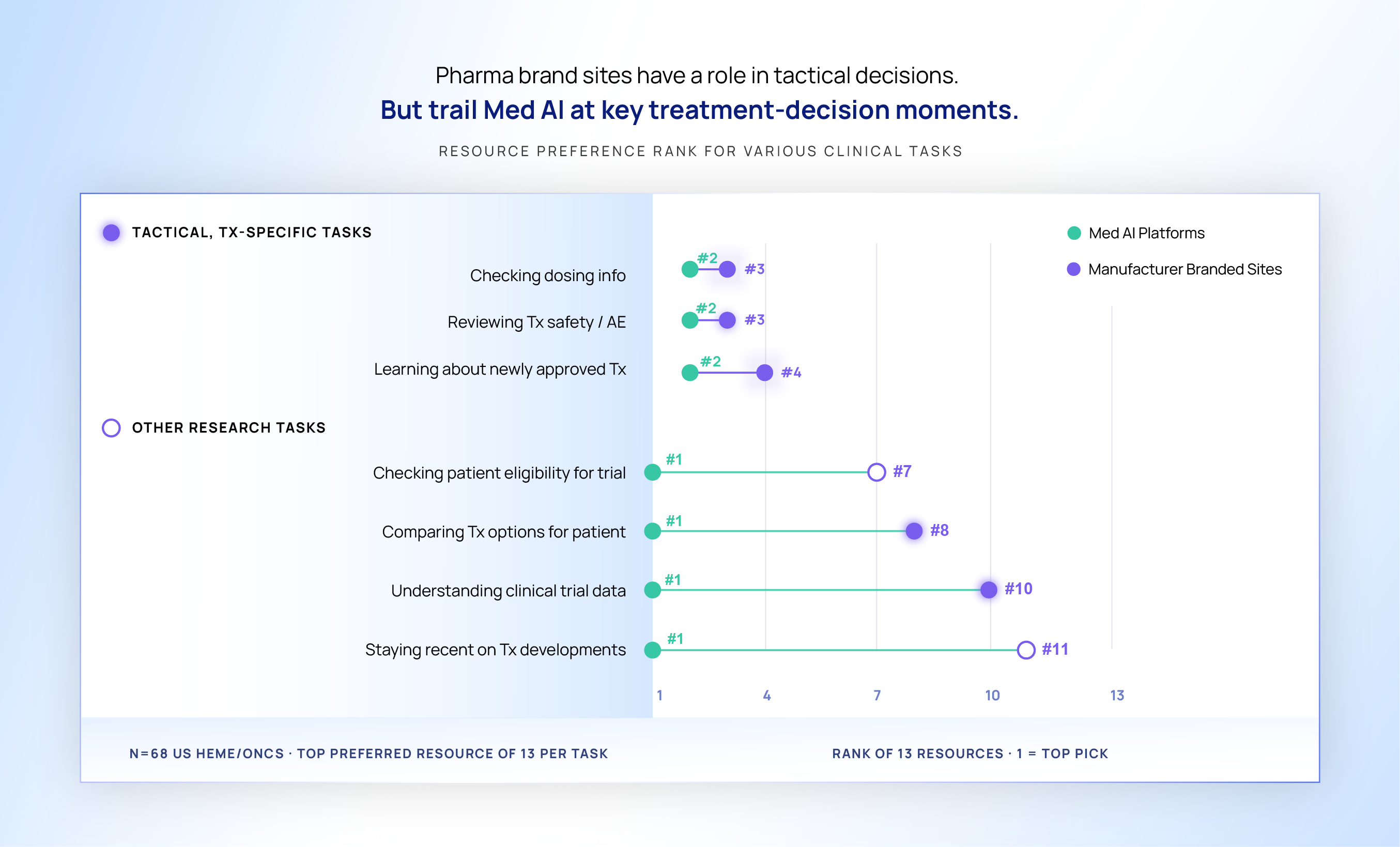
The short answer is yes. But the brand website's value is now concentrated in two specific, distinct functions — not the broad evaluative role it once held. Understanding this distinction is the starting point for rebuilding a digital measurement framework that reflects how physician research actually works.
Function 1: Defend the Tactical Niche
ZoomRx data shows that for tactical, treatment-specific queries — verifying dosing, checking safety information, accessing data on newly approved therapies — manufacturer websites remain the #3 preferred resource among Heme/Onc physicians. These are the moments when physicians require the official label, or when recent approvals or updates haven't yet reached AI or clinical decision support (CDS) systems.
This tactical niche is durable. It maps to high-stakes, label-dependent moments that require authoritative sourcing. Brand teams should invest in content architecture and site performance specifically optimized for these use cases — not for the broad evaluative role that AI has already absorbed.
Suggested Read: Physician AI Adoption Has Crossed Every Generation. The Data Proves It.
Function 2: Feed the AI Ecosystem
ZoomRx tracked Google AI Overview exposure among its Heme/Onc panel in Q1 2026. Among the physicians who encountered an AI Overview (65.1% of the panel), 43% of those overviews referenced at least one manufacturer or branded site. Critically, 73.2% of those referenced sites already ranked in the top five organic search results.
Traditional SEO is the most reliable predictor of AI Overview inclusion. The implication is direct: the brand website, properly structured and indexed, becomes the foundational source material that AI summarizes and cites. A brand that has allowed its SEO fundamentals to erode is losing visibility not only in search — it is losing it in every AI synthesis downstream.
The Metric That Matters: AI Share of Voice
For pharma digital teams operating in this environment, direct website traffic is no longer the primary proxy for digital health. The defining question has shifted: when a physician asks OpenEvidence to compare treatment options or evaluate trial data, does your brand appear in the answer?
ZoomRx calls this AI Share of Voice. Measuring it requires behavioral infrastructure that passively captures physician AI interactions — the specific queries asked, the AI responses generated, and whether your brand is represented. This is not a metric available in Google Analytics. It requires a purpose-built observational panel.
Conclusion
ZoomRx Digital Tracker provides exactly this capability — passively capturing verified HCP digital behavior across all channels, including medical AI platforms, and measuring AI Share of Voice at the brand level. If your team is re-evaluating how to measure digital performance in an AI-first environment, start with the behavioral data. The full white paper details the evidence base and strategic framework.

Frequently Asked Questions