·
4 minute read
·
4 minute read

With approximately $4B in RRMM revenue at risk, behavioral data shows the BMS pipeline CELMoDs are capturing HCP's attention — well ahead of FDA approval.
In a Nutshell
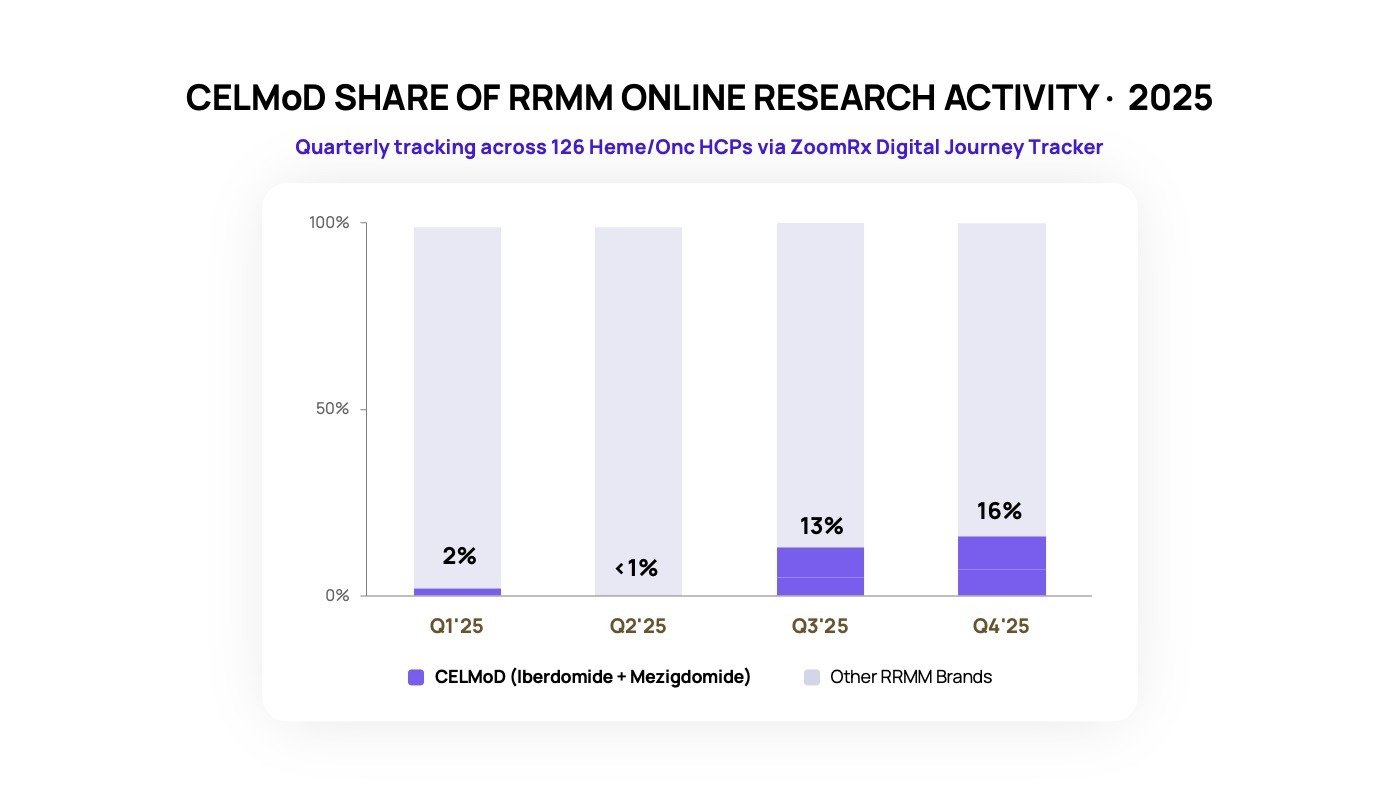
- CELMoDs are already a competitive force. Iberdomide and Mezigdomide climbed from near-zero visibility at the start of 2025 to a combined 16% share of HCP digital attention by Q4 — a steady, month-over-month rise, not a one-time spike.
- $4B+ is on the line for BMS. Pomalyst's approaching loss of exclusivity and the 2026 sunsetting of Revlimid settlements put a combined $4B in annual U.S. revenue at risk, making a successful CELMoD launch critical to BMS's near-term growth strategy.
- Attention precedes prescribing. As ZoomRx's analysis of Zepbound's launch demonstrated, shifts in HCP browsing behavior predict downstream changes in market share.
- Mid-line therapies are most exposed. HCPs are reshaping their mental algorithms to include CELMoDs — a shift that threatens to push incumbent 2L and 3L options into later-line salvage roles.
BMS is executing a high-stakes portfolio pivot in Relapsed/Refractory Multiple Myeloma — and the market is already moving with it. ZoomRx behavioral data from 126 hematology and oncology HCPs, captured through the Digital Journey Tracker, shows that Iberdomide and Mezigdomide closed 2025 with a combined 16% share of HCP digital attention.
For brand teams managing mid-line RRMM therapies, the signal is clear: The battle for share of mind is already well underway, and the window to respond is rapidly closing.
BMS's $4B+ Bet on Next-Gen CELMoDs
The RRMM market spans over a dozen FDA-approved therapies generating roughly $16B in annual revenue. BMS has long held a commanding position here, anchored by Revlimid and Pomalyst. However, BMS's position is at risk.
BMS faces a compounding revenue threat. Pomalyst's approaching loss of exclusivity puts $2.3 billion in annual revenue at risk. Furthermore, the 2026 sunsetting of Revlimid settlements — which have until now restricted generic entry — exposes an additional $2 billion . Together, these headwinds make the CELMoD transition one of the most consequential portfolio pivots in BMS's near-term pipeline. Iberdomide and Mezigdomide are BMS's answer: a more potent, orally administered successor class built to defend 2L share and recapture the Pomalyst patient population.
to 16% by Q4-2025
regulatory filing
regulatory filing
CELMoDs Climb from Pipeline to Active Consideration
Throughout 2025, entrenched treatments like Carvykti and Darzalex continued to dominate HCP digital attention. But beneath the surface, a meaningful shift began to take hold. ZoomRx tracked CELMoD engagement across 126 Heme/Onc HCPs, revealing two distinct
PAT T E R N 1
Steady climb to meaningful share of attention
Starting from near-zero visibility, Iberdomide and Mezigdomide climbed to a combined 16% share of attention by Q4 — rivaling active mid-line competitors. This steady rise suggests systematic interest among HCPs rather than fleeting awareness.
PAT T E R N 2
Shifting context — from pipeline to practice
CELMoDs are increasingly appearing in research activity alongside current standards of care. This signals that physicians are already mentally sequencing these therapies into complex regimens — viewing them as future tools to deploy, not just pipeline concepts to watch.
Underpinning this momentum is a powerful combination: compelling clinical data paired with the practical appeal of an oral administration profile.
Digital Attention Is a Leading Indicator
ZoomRx research shows that HCP browsing behavior prefigures prescribing habits — often by several quarters. In the obesity market, Zepbound's rising share of HCP digital attention preceded its revenue catch-up with Wegovy by multiple quarters. Physicians were researching and mentally repositioning Zepbound well before prescription data showed any movement.
The 16% share of HCP browsing attention CELMoDs have already captured is a leading indicator of future prescribing intent.
The CELMoD trajectory mirrors the pre-launch behavioral patterns ZoomRx observed in categories where market disruption followed — often within two to three quarters of sustained attention growth.
The Squeeze on Mid-Line Therapies As
As HCPs begin reshaping their mental algorithms to include CELMoDs, therapies currently sitting in the 2L and 3L settings face immediate risk. Options that differentiate on convenience, such as Xpovio (selinexor), are especially vulnerable to being pushed back or replaced entirely.
This displacement extends beyond the second line to cascade downward through the treatment sequence. If payers introduce generic step edits before CELMoDs, this shift could harden commercially, effectively forcing incumbent therapies into a later-line salvage role.
⚠️ R I S K S I G N A L
Mid-line 2L/3L RRMM therapies face displacement risk as CELMoD consideration accelerates. Brands relying on "wait and see" intelligence strategies will be too late to respond effectively.
It is important to note that this is currently a shift in consideration — taking place during the evaluation phase, well before prescribing patterns formally change. While that nuance makes the trend harder to detect with conventional tools, it highlights a valuable opportunity to engage early.
What This Means for Your Brand
With approvals for CELMoDs approaching, midline RRMM brand teams have a narrowing window to defend their positions, meaning mid-line incumbents must act now:
-
Re-validate the clinical niche: Sharpen messaging that highlights patient types where your therapy outperforms the
incoming class. Generic differentiation won't hold against a more potent and convenient oral successor. - Engage early:The "wait and see" approach is no longer viable. Digital attention is shifting today, and market share will follow tomorrow. HCPs are building mental frameworks now.
HCP attention is the leading indicator, and it's already moving. The question for RRMM brand teams isn't whether CELMoDs will reshape the competitive landscape — it's whether your brand will be visible and persuasive enough in the consideration phase to weather that disruption. Brands that act on behavioral intelligence now will be in a stronger position when approval lands. Those that wait for secondary data will be on the back foot in their response.
See Attention Trends in Your Therapeutic Area
ZoomRx's Digital Journey Tracker provides real-time visibility into HCP browsing behavior across 5,000+ life science websites — giving brand teams the intelligence to track competitive attention shifts before they surface in secondary data.
DATA SOURCE NOTE: Analysis based on real-time digital browsing data captured from 126 hematology and oncology HCPs via the ZoomRx Digital Journey Tracker, in 2025. All attention share figures reflect relative HCP time spent engaging with treatment-related content across tracked websites.